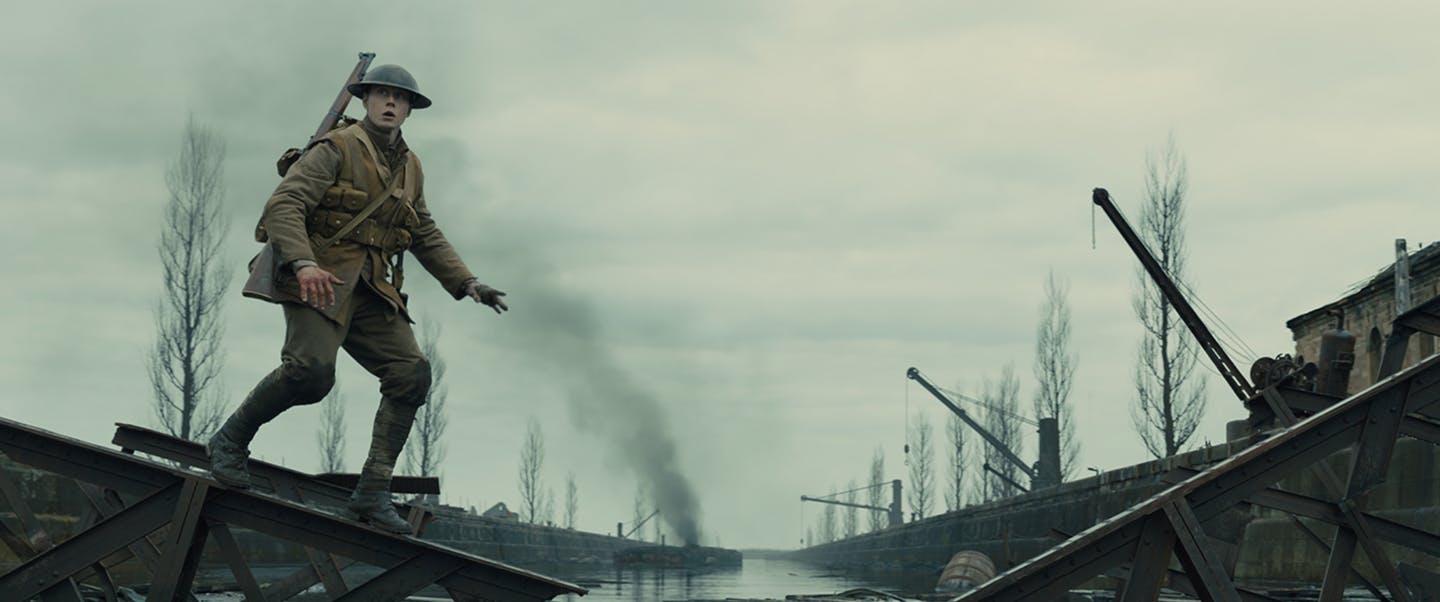
Continuing the buildup for Little Women (at this point, my white whale), this week I saw a few other films – it is, after all, the most wonderful, awardy time of the year. This also the cause of this week’s lateness; something I thought I could get away with since I only have about four readers, but have received a number of recent complaints about. SORRY. I’m overwhelmed with choice at the moment.
Despite this overload, one that’s been on my mind a lot is Sam Mendes’ 1917, one of the current frontrunners for Best Picture along with Bong Joon Ho’s Parasite. I had the rare pleasure of seeing this with my little brother, who is not a huge fan of movies but does like a good dose of history and “at least five explosions”, and after tantalising him with the trailers he was fully on board with 1917.
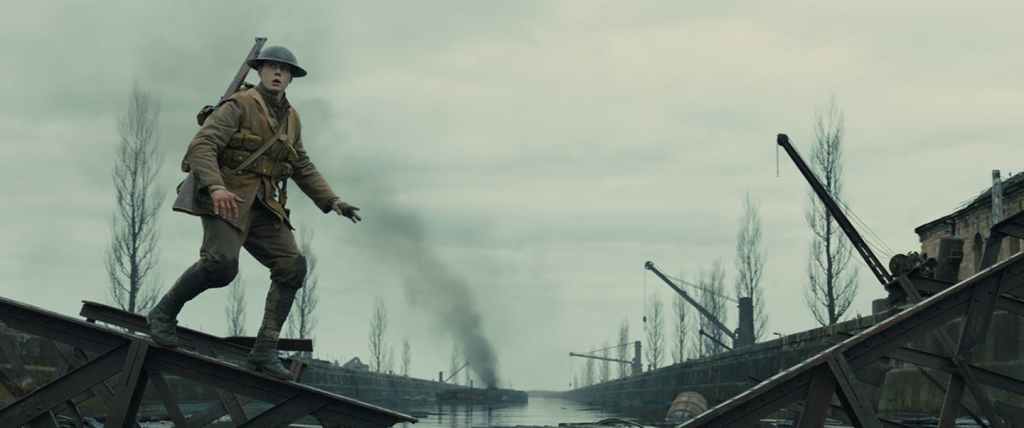
To get the obvious out of the way, this is an incredibly well-done war film, and a beautiful film in general. The film’s style of being made to look like one continuous take was not at all a central draw for me, and I was edgy about being drawn into a mediocre story which relied too much on one camera gimmick. I was very wrong. Director Sam Mendes and cinematographer Roger Deakin (nominated, rightfully, for his 15th Academy Award) masterfully weave 1917 into an unbroken experience, where time passes almost the same for the characters and the audience. This approach is so much more multifaceted than I anticipated – it creates creeping tension, then nauseatingly pulls us through danger as we run along beside the soldiers, then hovers peacefully as characters pause for discussion and reflection. Not a second felt wasted, and never cutting between scenes meant that I was completely immersed in what was happening.
The cast is strong: partly the various cameos by Posh Men from BBC Dramas™, but mostly the fantastic central pairing of Dean-Charles Chapman (Tommen from Game of Thrones) and George Mackay (from a bunch of stuff, but I especially loved him in Pride). This is a film of incredibly sparse, economical dialogue, and Chapman and Mackay draw out warmth, humour and nuance in the brief interactions between the two men.
Honestly, it’s difficult to pick any weaker technical elements – everything from the production design to the scoring seems to fit just right, without drawing attention away from the action. The premise of the film is so simple, and its execution so effortlessly correct, that I’ve been finding it quite difficult to explain.
That said, despite its strengths and overall sleekness, I couldn’t help feeling that there’s something under the surface of 1917 that would like to inch its way out. The notion that Blake is chosen for the mission not because of heroism or sacrifice, but because he will be uniquely motivated to save his brother presents murkier implications about the morale of the army at that time – an interesting can of worms that Mendes doesn’t really touch.
I appreciate the relatively light touch in how we are introduced and familiarised with the films’ characters – it’s very show-don’t-tell, and falls gently within familiar archetypes (young and naive paired with wiser and more cynical) without becoming obnoxiously cliche. A conversation about selling a medal for a bottle of wine provided a good example of this approach, telling us a huge amount about the experiences and outlook of each man without actually giving much concrete exposition or information about their lives.
I also think this is an effective mechanic for telling stories about war and trauma – it’s impossible to capture the suffering of hundreds upon thousands of soldiers, so maybe this ‘everyman’ approach is a kind of compromise. We empathise with Blake and Schofield, but also recognise them for what they are – relatively opaque sketches, representing a multitude of people and experiences.
That said, I agree with Richard Brody’s skepticism of this approach to characterisation. Every sense that we get of Blake and Schofield’s lives are external, and their only motivation is to survive, to follow orders, to keep on pushing. In a film this concerned with how it looks – and, to be fair, a film that looks this good – it’s hard not to get a very vague whiff of superficiality.
It’s not doing anything particularly groundbreaking or new, and it might not be the most exciting candidate for Best Picture. But what 1917 is doing, it’s doing incredibly well.
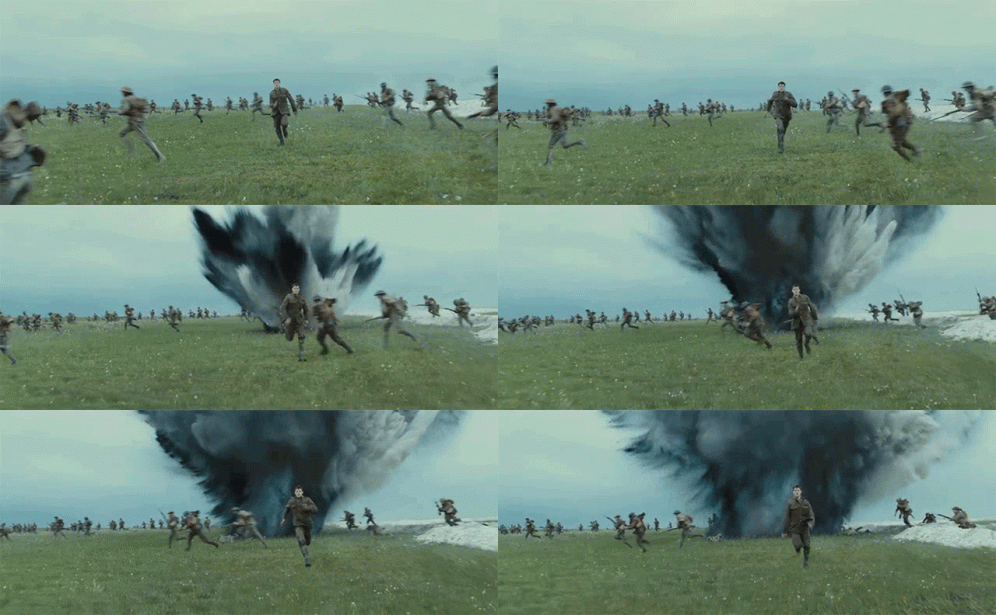
To wrap up, here are the (spoiler-free) five times I cried:
- After the Plane Crash (proper cry – silent but screwy-up-faced)
- Babysitting (more of a moist-eye moment than a full tear expulsion)
- That Running Bit from the Trailers (tense/man, war is bad cry)
- Ol’ Brave-faced Robb (mild, exhausted cry)
- Under the Tree (elegant single tear)

